Day 1 of Becoming an AI Developer: AI vs ML vs Deep Learning vs GenAI
Starting your AI journey as a developer? This 30-day roadmap will help you transition into AI step by step — no random tutorials, no confusion, just practical learning.
Thumbnail Image
You’re Probably Learning AI the Wrong Way
Most developers who want to switch to AI make the same mistake.
They open YouTube.
Watch 17 different tutorials.
Get overwhelmed by terms like LLMs, transformers, embeddings, neural networks, fine-tuning, and suddenly feel like:
“Maybe AI is only for researchers.”
It’s not.
In fact, if you’re already a developer, you’re much closer to AI than you think.
You already know:
APIs
Logic building
Backend systems
Debugging
Data structures
Problem solving
The only thing missing?
A structured path.
And that’s exactly what this series is for.
Welcome to Day 1 of a 30-Day AI Transition Series for Developers.
By the end of this series, you’ll understand how modern AI systems work, build real projects, work with LLMs, prompts, RAG, agents, embeddings, fine-tuning concepts, and become confident enough to transition into AI-focused roles.
And no, you won’t need 50 different resources.
This series will be enough.
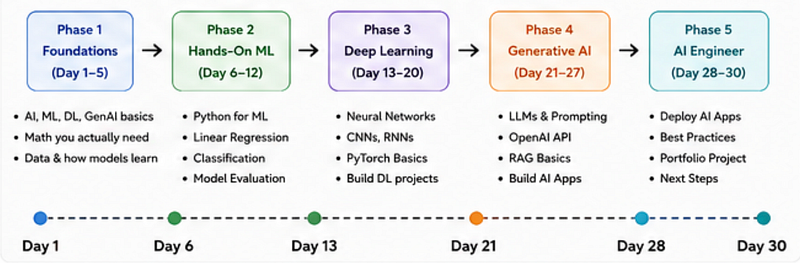
Image — 30-Day AI Learning Roadmap timeline
What You’ll Learn Today
Today, we’ll clear up one of the biggest confusions in AI.
What’s the actual difference between:
Artificial Intelligence (AI)
Machine Learning (ML)
Deep Learning (DL)
Generative AI (GenAI)
Because honestly?
Many developers use these words interchangeably.
And that creates confusion from Day 1.
Let’s fix that.
AI: The Big Umbrella
Think of Artificial Intelligence as the broader goal.
AI simply means:
Building systems that can mimic human intelligence.
Examples include:
Recommendation systems
Fraud detection
Chatbots
Self-driving systems
Voice assistants
But here’s the important part:
Not all AI learns automatically.
Some systems are rule-based.
Example:
function supportBot(question) {
 if (question.includes('refund')) {
 return 'Refund policy: 7 days';
 }
 return 'Contact support';
}
This is technically a basic AI system.
But it isn’t learning.
It follows predefined rules.
Why This Matters for Developers
A common mistake is assuming:
AI = ChatGPT
Nope.
ChatGPT is only one category of AI.
Understanding the hierarchy will remove a lot of confusion later.
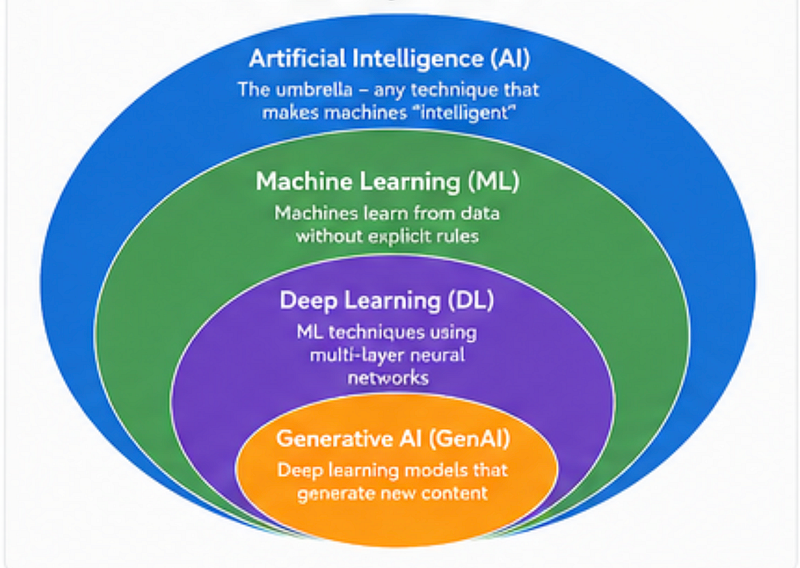
Image — AI → ML → Deep Learning → Generative AI
Machine Learning: Systems That Learn From Data
Machine Learning is a subset of AI.
Instead of writing explicit rules, you train systems using data.
Traditional coding looks like this:
Traditional Programming
Input + Rules → OutputMachine Learning works like this:
Machine Learning
Input + Output Data → Model Learns RulesFor example:
Instead of hardcoding spam detection:
if(email.includes('FREE MONEY')) {
 return 'Spam';
}
ML trains on thousands of emails and learns patterns automatically.
Real-world examples:
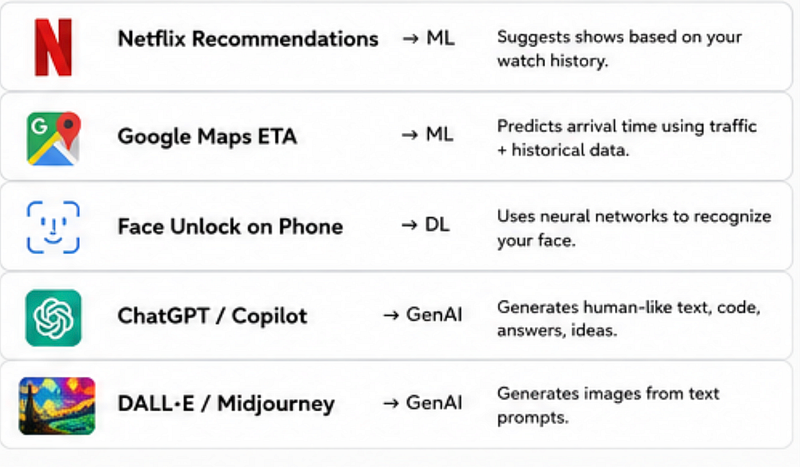
Image — Describing how companies using AI
Surprising Insight
Most companies using “AI” are actually using Machine Learning.
Not fancy robots.
Not AGI.
Just good prediction systems.
Deep Learning: When Neural Networks Enter the Picture
Deep Learning is a subset of Machine Learning.
This is where things become powerful.
Deep Learning uses neural networks inspired by how the brain processes information.
Why is this important?
Because traditional ML struggles with:
Images
Audio
Human language
Complex pattern recognition
Deep Learning changed that.
Examples:
Face unlock on phones
Speech recognition
Translation systems
Medical image detection
Simplified Neural Network Example
Input Layer → Hidden Layers → OutputExample:
Dog image → Neural Network → “Dog Detected”
The more data and training, the smarter the model becomes.
Developer Perspective
Here’s something most beginners misunderstand:
You do NOT need to become a math researcher to enter AI.
Especially in 2026.
Many AI-forward engineering roles care more about:
Using APIs
Building products with AI
Prompt engineering
Evaluation systems
Retrieval systems (RAG)
LLM orchestration
Math helps.
But building matters more for many roles.
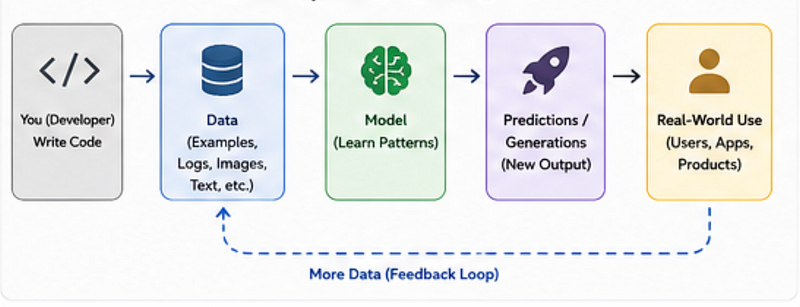
Image — Explaining Developer’s mental model
Generative AI: The Part Everyone Is Talking About
Generative AI is what has exploded recently.
Instead of predicting something…
It creates something new.
Examples:
Text generation
Image generation
Code generation
Video generation
Audio generation
Examples you already know:
ChatGPT
GitHub Copilot
Claude
Midjourney
Gemini
Generative AI is mostly powered by Large Language Models (LLMs).
These systems are trained on huge datasets to predict the next token.
Sounds simple.
But that simple prediction creates surprisingly intelligent behavior.
Your First AI Hello World Project
Enough theory.
Let’s write your first AI code.
Install OpenAI SDK
npm install openaiBasic Chat Example
import OpenAI from 'openai';
const client = new OpenAI({
 apiKey: process.env.OPENAI_API_KEY,
});
async function run() {
 const response = await client.chat.completions.create({
 model: 'gpt-4.1-mini',
 messages: [
 {
 role: 'user',
 content: 'Explain AI like I am a frontend developer'
 }
 ]
 });
 console.log(response.choices[0].message.content);
}
run();
What This Code Does
This is your first interaction with an LLM.
You:
Connect to OpenAI
Send a prompt
Receive AI-generated output
That’s it.
You just used Generative AI programmatically.
Common Beginner Mistake
Many developers think:
“I need to build my own model.”
No.
Most AI engineers today build on top of foundation models.
Exactly like developers use cloud services instead of building servers from scratch.
Note- You can generate your OpenAI free key here or you can use ollama for running AI models locally, install it here
Use this code for ollama
import ollama from "ollama";

async function run() {
 const response = await ollama.chat({
 model: "llama3",
 messages: [
 {
 role: "user",
 content: "Explain AI like I am a MERN developer",
 },
 ],
 });

 console.log(response.message.content);
}

run();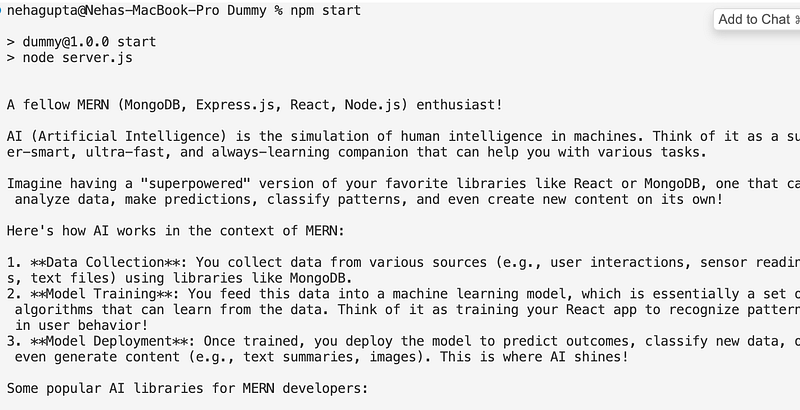
Output of above ollama chat
Mini Project (Day 1)
Build this today:
AI Career Coach CLI
Input:
node app.jsUser enters:
I know React and Node.js. How do I move into AI?Output:
AI generates a roadmap.
Why This Project Matters
You’ll learn:
API integration
Prompting basics
AI response handling
Environment variables
LLM workflows
Small project.
Huge confidence boost.
What’s Coming in the Next 30 Days?
Here’s a preview:
Prompt Engineering
LLMs Explained Simply
Embeddings
Vector Databases
RAG Systems
AI Agents
Fine-Tuning Concepts
Building AI Projects
Deploying AI Apps
AI Career Transition Strategy
By the end?
You won’t just understand AI.
You’ll be able to build with it confidently as a developer.
Key Takeaways
If you remember only one thing from today, remember this:
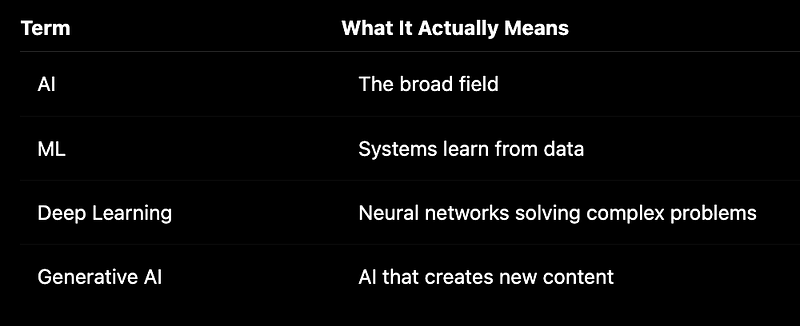
AI VS ML VS DL
The Surprising Payoff
Here’s what most developers realise too late:
The biggest barrier to entering AI isn’t math.
It’s confusion.
Once the roadmap becomes clear, progress becomes much faster.
And that’s exactly what this series is designed to solve.
Question for you:
What’s the one thing about AI that feels confusing right now? Drop it below — I’ll cover the most common questions in upcoming articles.
Day 2: How Large Language Models (LLMs) Actually Work Without the Confusing Math